

The brief
Catholic formation online was scattered across YouTube playlists, PDFs of the Catechism, and forum threads. Serious students of the faith had no way to test whether they actually understood the arguments, no way to measure their grasp of historical sources, and no daily rhythm. Apps in the space were devotional-only or content-only. Nothing combined assessment, argument, history, and prayer in one system.
The founders came to us with one constraint: the site had to argue with the user. Not lecture. Not gamify devotion. Test the logic, surface the sources, and let the user follow an argument all the way to its end.
The archetype intake
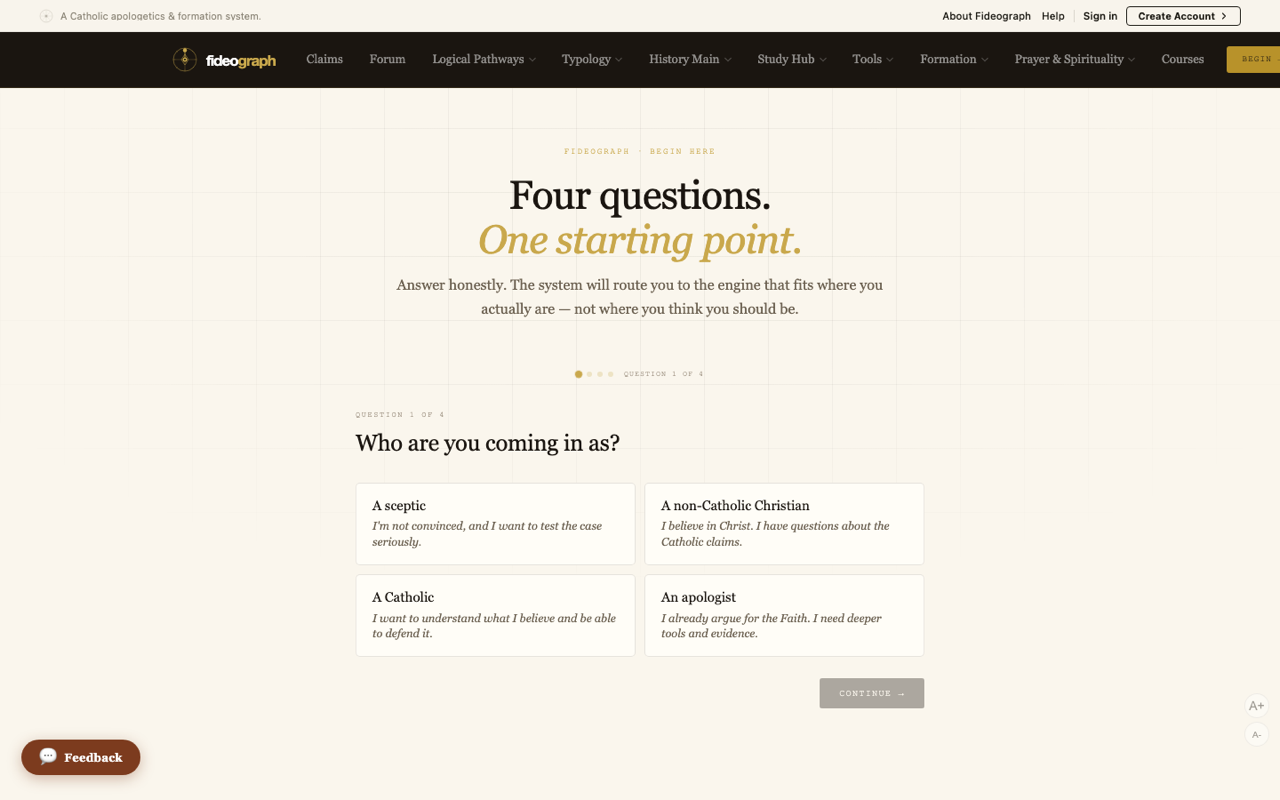
Every visitor starts with four questions. The system routes them to the engines that match where they actually are — sceptic, non-Catholic Christian, returning Catholic, apologist. The path is reshaped by the answers, not the marketing.
Engine one — Logical Pathways
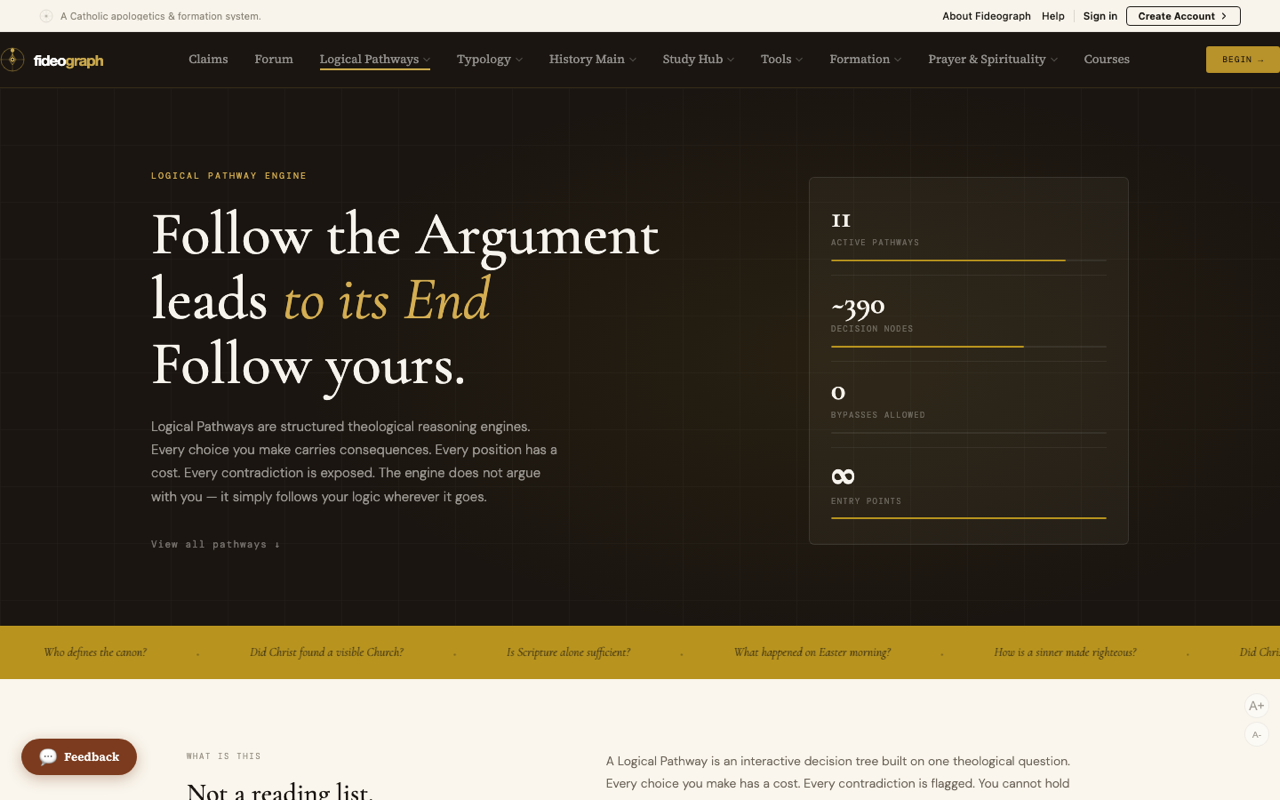
A decision-tree engine built around theological reasoning. Every node is a real argument with cited consequences. Pick a position; the engine follows the implications to their logical end, not where you hoped they would land. The reading surface is unapologetically literary — printed-missal typography, no UI noise, the argument front and centre.
Engine two — Historical Simulation
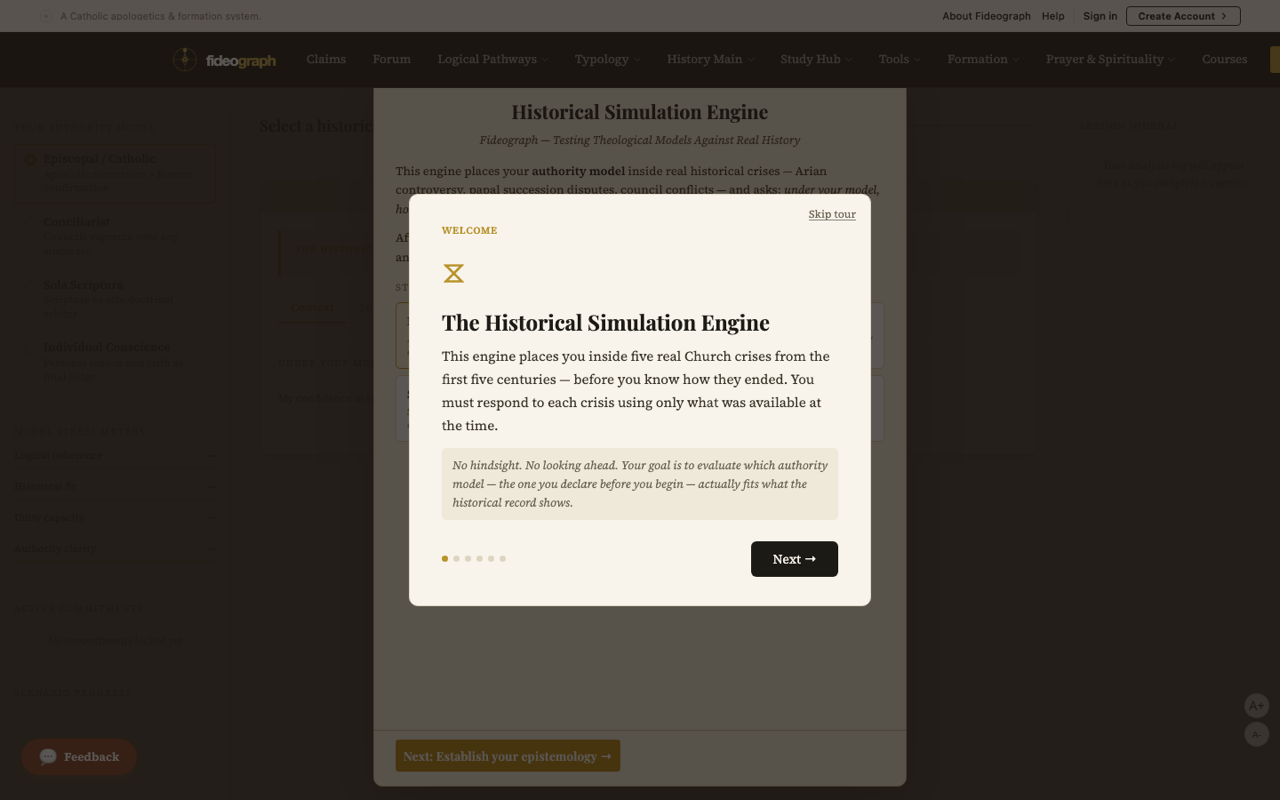
The simulation drops the user inside five real Church crises from the first five centuries — Arian controversy, papal succession disputes, council conflicts — before they know how each ended. Choose your authority model up front (Episcopal, Conciliarist, Sola Scriptura, Individual Conscience) and answer the way you would have. Then we score the answer against what the historical record actually shows.
Engine three — Patristic Citation
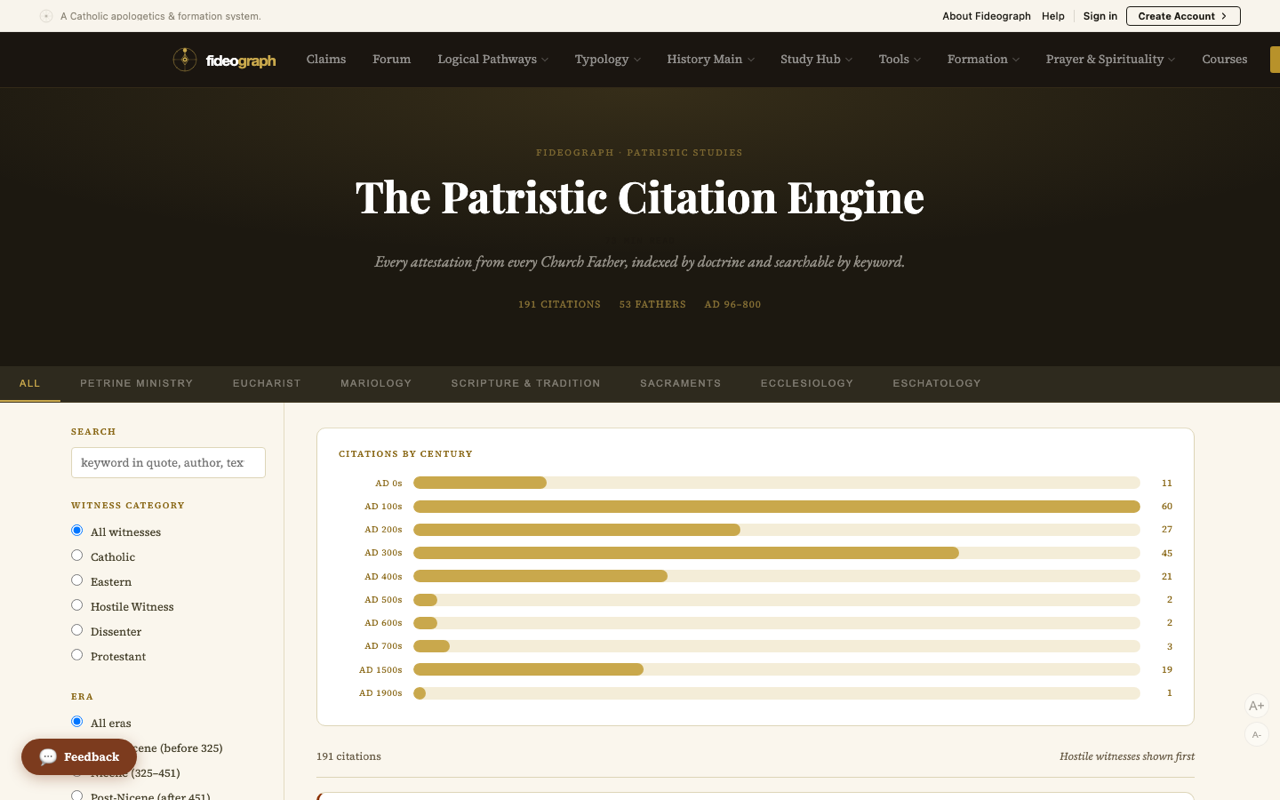
The hardest engine to build, and the most distinctive. Every attestation from every Church Father, indexed by doctrine, century, era, and witness category (Catholic, Eastern, hostile, dissenter, Protestant). Search by keyword, filter by doctrine, surface every primary source. A density chart shows how often a teaching is attested across the centuries. Hostile witnesses are highlighted so the engine cannot be accused of cherry-picking.
Engine four — Belief Map
A timeline of what the first five centuries believed, mapped across 217 belief records, 46 figures, and six traditions (Catholic, Orthodox, Lutheran, Reformed, Baptist, Evangelical). Toggle between the Apostolic, Patristic, Conciliar, and Post-Conciliar eras. Compare any two figures side by side. See where the traditions converge, diverge, and oppose.
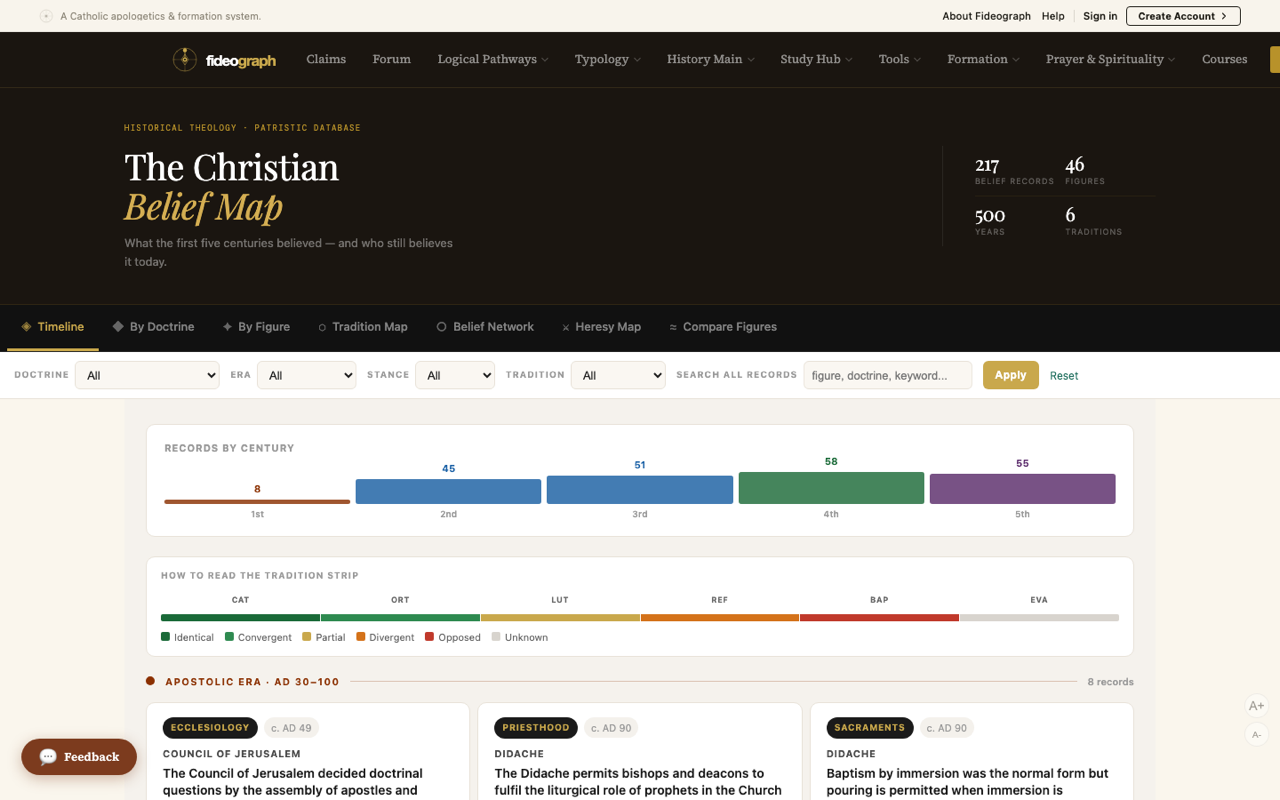
Engine five — Quiz and Typology
The quiz engine carries 133 verified questions across three modes (explain, test, challenge) with doctrine-strength meters that update as the user works through them. Typology adds seven deep-dive series on Old Testament types and their New Testament fulfilments. Both feed the same progression dashboard.
The publishing layer
Everything runs on a hardened WordPress backend. Engines are first-class custom post types with their own admin surfaces, validation rules, and authorship flows. The patristic database is a relational store sitting next to WordPress so the editorial team can add citations without touching code. We built the theme, the engine plugins (Logical Pathways, Historical Simulation, Citation Engine, Belief Map, Quiz, Typology), the forum, the courses module, and the admin dashboards.
The mobile companion
The website is the product. The mobile app is the daily-use surface — Expo / React Native, one codebase shipping to iOS and Android, fed by the same WordPress publishing pipeline. Apple Sign-In, offline pre-fetch for seven days of content, voice memo journaling, and deep links into any engine state on the web. Native auth and native deep linking, but no second editorial system.
What the platform proves
Fideograph proves a thesis we have wanted to build into for years: that serious subject matter deserves serious software. Five reasoning engines, a 217-record belief database, a 191-citation patristic index, and a mobile app — all editable by a non-technical team, all running off one publishing source, all built to be argued with rather than scrolled.